
Ancient Rome Toilets: 7 Bizarre Facts About Public Latrines
By Trivia Daily, History Desk — Published July 20, 2026
Table of Contents
- Key Takeaways
- Ancient Rome Toilets Eliminated All Privacy
- The Communal Sponge Stick Replaced Toilet Paper
- Public Latrines Served as Social Centers
- Sewer Gas Explosions Were a Real Danger
- Slaves Warmed Toilet Seats for Wealthy Romans
- Frequently Asked Questions
The Roman Empire revolutionized countless aspects of civilization, from roads to aqueducts. Yet one of its most fascinating—and peculiar—innovations was the public latrine. Ancient Rome toilets were far more than simple necessities; they were social hubs where citizens gathered, conversed, and conducted business while attending to nature’s call. These communal facilities reveal surprising insights into Roman culture, hygiene practices, and daily life during an era when privacy held vastly different meaning than it does today.
Walking into a Roman public latrine meant entering a world without stall doors, toilet paper, or personal space. The empire’s approach to sanitation was both ingeniously advanced and startlingly alien to modern sensibilities. From shared sponge sticks to explosive sewer gas incidents, the history of ancient Rome toilets offers a window into the everyday realities of one of history’s greatest civilizations.
Key Takeaways
- Roman public latrines featured long stone benches with holes arranged in rows, allowing dozens of people to use the facilities simultaneously without any partitions or privacy.
- Romans used a communal sponge on a stick called a tersorium instead of toilet paper, rinsing it in a channel of flowing water between uses.
- Public toilets doubled as social gathering spaces where Romans discussed business, politics, and daily gossip while side-by-side.
- Sewer gas explosions were a genuine hazard, as methane buildup in ancient Rome’s Cloaca Maxima could ignite and cause injuries.
- Wealthy Romans often sent slaves to public latrines first to “warm the seat” before they arrived.
- The flowing water beneath toilet seats did not flush waste directly but instead carried it through elaborate sewer systems to the Tiber River.
Ancient Rome Toilets Eliminated All Privacy
The most jarring aspect of Roman public latrines for modern observers is the complete absence of privacy. These facilities featured long marble or limestone benches with keyhole-shaped openings cut at regular intervals. Users sat shoulder-to-shoulder, sometimes accommodating twenty to fifty people at once in larger establishments. No partitions, curtains, or doors separated individuals. This arrangement wasn’t an oversight—Romans simply didn’t associate bathroom activities with privacy the way contemporary cultures do.
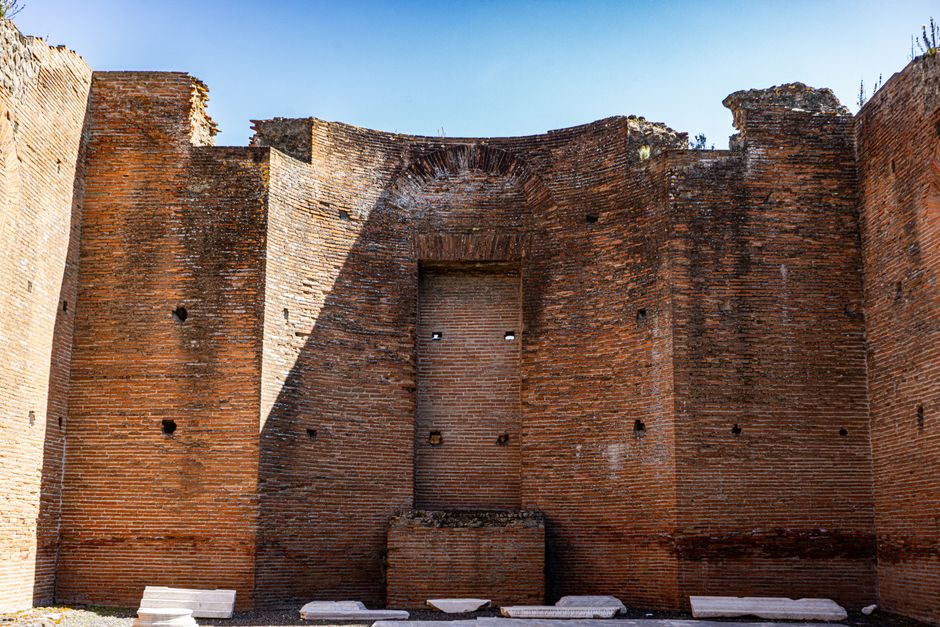
Archaeological excavations across the Roman Empire, from Ostia Antica near Rome to Ephesus in modern-day Turkey, reveal remarkably consistent latrine designs. The benches typically lined three walls of a rectangular room, with elaborate mosaics or frescoes decorating the spaces. Some facilities even featured statues of Fortuna, the goddess of luck, suggesting Romans sought divine favor even in their most vulnerable moments. The open design served practical purposes too: it allowed for better ventilation in an era before modern plumbing and helped attendants monitor the facilities.
The Communal Sponge Stick Replaced Toilet Paper
Romans wiped themselves with a tersorium—a sea sponge affixed to a wooden stick. Here’s the truly bizarre part: these sponges were communal. After use, Romans rinsed the tersorium in a channel of constantly flowing water that ran along the floor in front of the toilet benches. The next person would then use the same sponge. This practice was standard across the empire for centuries.
The flowing water channel served dual purposes. It provided a rinsing station for the tersorium and also carried away any waste that missed the main openings. Some historians debate whether Romans used the sponges directly or wrapped them in cloth, but ancient sources suggest direct contact was common. Vinegar or salt water sometimes replaced plain water in the channels, possibly as a crude disinfectant. The shared nature of these implements would have exposed users to numerous pathogens, though Romans had no concept of germ theory to understand these risks.
Public Latrines Served as Social Centers
Romans treated their toilet visits as social occasions. Business deals were negotiated, political alliances formed, and neighborhood gossip exchanged—all while seated on the communal benches. This practice reflected broader Roman attitudes toward public versus private life. The forum, the baths, and even the latrines were extensions of civic participation. Wealthy merchants and politicians frequented the same public facilities as common citizens, though the most elite Romans maintained private latrines in their homes.
Some Roman writers referenced latrine conversations in their works. The philosopher Seneca mentioned the noise and chatter of public baths and latrines as unavoidable aspects of urban life. This social dimension meant latrines were often architecturally impressive, featuring columns, decorated floors, and even heated seats in some facilities. They were designed to be comfortable spaces for lingering, not quick stops for urgent relief.
Sewer Gas Explosions Were a Real Danger
The Cloaca Maxima, Rome’s great sewer system, was an engineering marvel that channeled waste from across the city into the Tiber River. However, methane gas produced by decomposing organic matter accumulated in these underground passages. When concentrations reached critical levels and met an ignition source—perhaps a dropped oil lamp or a spark—explosions could occur. These blasts sometimes traveled up through toilet openings, causing burns and injuries to unsuspecting users.
Roman sources document these incidents, though they were likely rare enough to be noteworthy when they happened. The danger was real enough that some Romans made offerings to Cloacina, the goddess who protected the sewer system. The risk highlights an often-overlooked aspect of ancient engineering: sophisticated infrastructure came with sophisticated hazards. Modern sewer systems prevent methane buildup through venting and gas management systems that the Romans lacked.
Slaves Warmed Toilet Seats for Wealthy Romans
Wealthy Romans sometimes dispatched slaves to public latrines ahead of their arrival with a specific task: sitting on the cold stone seats to warm them. This practice, mentioned by several Roman writers, reveals both the discomfort of marble benches in winter and the extreme inequalities of Roman society. Slaves held no bodily autonomy; their physical comfort was entirely subordinate to their masters’ convenience.
This custom also underscores that even affluent Romans regularly used public facilities rather than exclusively relying on private latrines. Home toilets existed but were less common than public installations. The public latrines connected to the city’s major sewer systems, while private facilities often used cesspits that required regular emptying—an expensive and unpleasant service. Public toilets thus offered a more convenient, if less private, alternative for all social classes.
The Flowing Water System Wasn’t Really a Flush
Modern readers might assume the water flowing beneath Roman toilet seats functioned like contemporary flush toilets. Not quite. The water ran continuously in channels beneath the openings, carrying waste along through gravity-fed systems. This constant flow required substantial water infrastructure—aqueducts brought millions of gallons daily into Roman cities, and a significant portion went toward sanitation. The system worked, but differently than modern plumbing.
Waste flowed from the latrines into the main sewer lines and eventually into rivers. Rome’s Cloaca Maxima, originally constructed in the 6th century BCE, remained functional for centuries and still exists today, though no longer carrying sewage. The engineering required to maintain proper water flow and gradient across miles of underground channels demonstrated remarkable technical sophistication. Yet the system had limits—blockages occurred, maintenance was difficult, and the rivers receiving the waste became polluted, contributing to disease outbreaks during the empire’s later centuries.
Urine Was a Valuable Commodity
Romans collected urine from public latrines for commercial purposes. The ammonia in urine made it valuable for several industries, particularly leather tanning and cloth cleaning. Fullers—ancient launderers—used urine to remove oils from wool and whiten togas. Large vessels called dolia were placed in public spaces, including latrines, specifically for urine collection. The practice was so profitable that Emperor Vespasian imposed a tax on urine collection in the first century CE.
When Vespasian’s son Titus complained about the disgusting nature of the tax, the emperor reportedly held up a gold coin to his nose and asked if it smelled bad. This incident gave rise to the Latin phrase “pecunia non olet”—money doesn’t smell. The story illustrates how Romans pragmatically exploited every resource, including human waste. Urine collection continued throughout the empire’s duration, representing an early form of recycling that modern societies have largely abandoned despite growing interest in circular economies.
Frequently Asked Questions
Did ancient Romans have toilet paper?
No, Romans used a tersorium—a sponge attached to a stick—which was rinsed in flowing water and shared among users. Some wealthier individuals may have used cloth or wool, but paper products were not employed for this purpose in ancient Rome.
Were Roman public toilets free to use?
Most Roman public latrines charged a small entrance fee, though the cost was minimal enough that even poor citizens could afford occasional use. Some facilities attached to bath complexes were included in the bathing fee.
How did Romans keep their public toilets clean?
Attendants called aquarii maintained the latrines, ensuring water channels flowed properly and cleaning the facilities regularly. The constant water flow helped carry away waste, though hygiene standards were far below modern expectations.
Why didn’t Romans build private bathroom stalls?
Romans didn’t associate bodily functions with shame or embarrassment the way many modern cultures do. Public bathing, exercising nude, and communal toilet use were normal aspects of civic life, making privacy partitions unnecessary in their cultural context.
The public latrines of ancient Rome remind us that concepts we consider universal—like bathroom privacy—are actually cultural constructs that vary dramatically across time and place. These marble-benched facilities, with their communal sponges and social atmosphere, functioned successfully for centuries in one of history’s most influential civilizations. Perhaps the strangest fact of all is that millions of Romans found this arrangement perfectly normal, even comfortable, proving that human adaptability extends even to the most intimate aspects of daily life.
