
⏱️ 7 min read
The animal kingdom continues to astound researchers and observers with displays of cognitive abilities that challenge our understanding of intelligence itself. From problem-solving prowess to emotional complexity, creatures across the globe demonstrate remarkable mental capabilities that rival and sometimes surpass human expectations. The following examples reveal extraordinary moments when animals have shown intelligence that fundamentally altered how scientists view non-human cognition.
Remarkable Demonstrations of Animal Cognition
1. The Crow That Understood Water Displacement
In a stunning recreation of Aesop’s fable, New Caledonian crows demonstrated an understanding of water displacement that would impress any physics student. Researchers presented crows with a tube containing water with a floating treat just out of reach. Without any training, the birds began dropping stones into the tube, raising the water level until they could access the reward. What made this even more impressive was their ability to select heavier stones when available and reject objects that wouldn’t sink, showing genuine comprehension of cause and effect rather than simple trial and error.
2. Alex the Parrot’s Revolutionary Language Skills
Alex, an African Grey parrot studied by Dr. Irene Pepperberg for 30 years, didn’t just mimic words—he understood them. This remarkable bird could identify over 50 objects, seven colors, and five shapes, and could count up to six items. More astonishingly, Alex could answer questions about objects’ attributes, demonstrating abstract thinking. When presented with a tray of mixed objects, he could answer complex questions like “What color is the triangle?” His final words to Dr. Pepperberg, “You be good. I love you,” suggested emotional intelligence that continues to provoke scientific debate.
3. Dolphins Call Each Other by Name
Marine biologists discovered that bottlenose dolphins develop unique signature whistles that function essentially as names. Research revealed that dolphins not only create these individual identifiers but also use them to call specific individuals, who respond to their own “names” even in recordings. This naming system represents one of the few examples of animals using learned labels to identify individuals, a cognitive feat previously thought exclusive to humans.
4. Elephants Demonstrate Self-Awareness in Mirror Tests
When researchers placed a large mirror in front of elephants at the Bronx Zoo, the pachyderms didn’t treat their reflections as other elephants. Instead, they used the mirror to examine parts of their bodies they couldn’t normally see, such as the inside of their mouths. One elephant, Happy, even investigated a white “X” painted on her forehead, indicating she recognized the reflection as herself—a level of self-awareness shared only with great apes, dolphins, and magpies.
5. Octopuses Unscrew Jars from the Inside
In aquarium settings worldwide, octopuses have repeatedly demonstrated problem-solving abilities that baffle their keepers. One particularly impressive skill involves opening lidded jars to obtain food—but even more remarkably, octopuses placed inside sealed jars have successfully unscrewed the lids from within to escape. This requires not only understanding the mechanics of the screw-top mechanism but also applying that knowledge in reverse, showcasing exceptional spatial reasoning and manual dexterity.
6. Chimpanzees Outperform Humans in Memory Tests
At Kyoto University, young chimpanzees consistently defeated human adults in short-term memory challenges. When numbers flashed briefly on a screen, chimps could remember and reproduce the sequence faster and more accurately than their human competitors. This “photographic memory” ability, particularly strong in young chimps, suggests that in specific cognitive domains, our closest relatives actually surpass human capabilities.
7. Ravens Plan for Future Needs
Swedish researchers discovered that ravens can plan for future events up to 17 hours in advance—a sophisticated cognitive skill. In experiments, ravens selected and saved specific tools they knew they would need later, even resisting the temptation of an immediate food reward in favor of a larger future payoff. This ability to delay gratification and plan ahead was previously considered uniquely human among cognitive abilities.
8. Border Collies Master Massive Vocabularies
A Border Collie named Chaser learned the names of 1,022 individual toys and could retrieve any specific item on command. More impressively, she understood basic grammar and syntax, distinguishing between “take ball” and “touch ball.” Chaser could also learn new words through inference, correctly identifying an unfamiliar object when asked to retrieve something whose name she hadn’t heard before—demonstrating fast mapping, a learning technique human children use.
9. Bees Communicate Complex Navigation Through Dance
Honeybees perform elaborate waggle dances that convey precise information about food sources, including direction, distance, and quality. Researchers decoded this dance language, discovering that bees can communicate locations up to several kilometers away with remarkable accuracy. Even more surprisingly, bees can adjust their dances to account for wind conditions and can “debate” with other scouts, changing their recommendations based on peer feedback.
10. Orcas Develop Cultural Hunting Techniques
Different orca pods have developed specialized hunting techniques passed down through generations, representing genuine cultural transmission. Some Antarctic orcas create coordinated waves to wash seals off ice floes, while others have learned to tip over ice sheets. In Patagonia, certain orcas intentionally beach themselves to catch sea lions, then wriggle back into the water—a dangerous technique mothers teach their young through careful demonstration.
11. Gorilla Uses Sign Language to Express Emotions
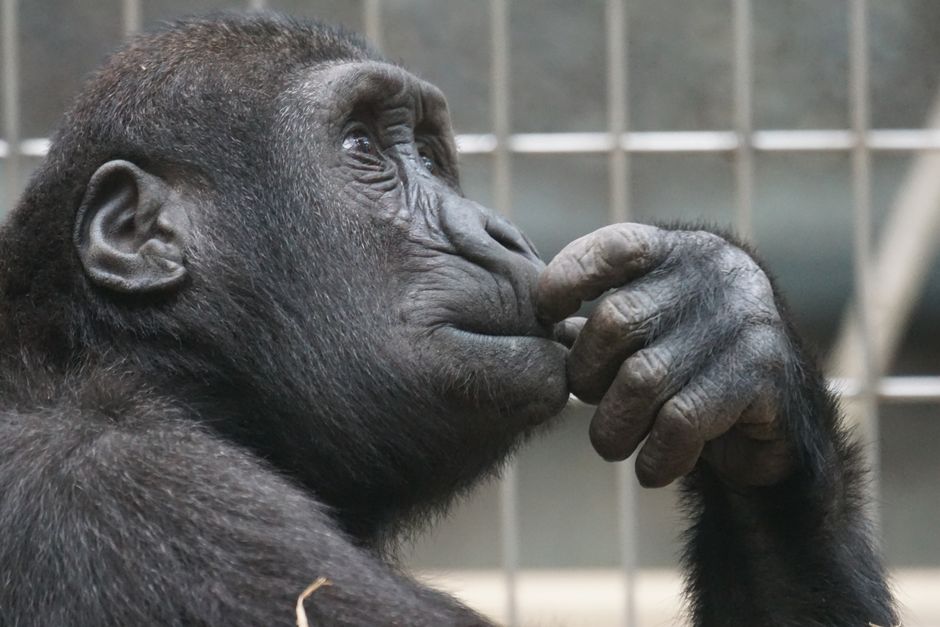
Koko, a western lowland gorilla, mastered over 1,000 signs in American Sign Language and understood approximately 2,000 spoken English words. Beyond simple communication, Koko expressed complex emotions, discussed past and future events, and even lied when she thought she might get in trouble. She famously requested a pet cat, named it “All Ball,” and showed genuine grief when the kitten died, signing “sad” and “frowning” for weeks afterward.
12. Pigs Navigate Complex Maze Systems
Despite their reputation, pigs demonstrate remarkable cognitive abilities, including mastering complex mazes faster than dogs and performing as well as chimpanzees in some tests. They can use mirrors to locate hidden food, showing understanding that the reflection represents real space. Pigs also demonstrate empathy, with studies showing they become stressed when observing other pigs in distress, indicating emotional intelligence alongside their problem-solving skills.
13. Squirrels Employ Deceptive Tactics
Grey squirrels have been observed performing elaborate fake food-burying rituals when they sense they’re being watched by potential thieves. They dig holes, pretend to deposit nuts, and carefully cover the empty cache—all while actually keeping the nut in their mouth. This tactical deception requires theory of mind: understanding that other squirrels have knowledge and intentions, and can be deliberately misled.
14. Archerfish Calculate Trajectory and Refraction
These remarkable fish shoot down insects from overhanging branches by spitting precisely aimed water jets. What makes this extraordinary is that archerfish must account for light refraction at the water’s surface, essentially calculating where the insect actually is versus where it appears to be. Young archerfish learn this complex physics through observation and practice, improving their accuracy over time through what can only be described as understanding ballistic principles.
15. Scrub Jays Remember What, Where, and When
Western scrub jays demonstrate episodic memory—the ability to remember specific events in context. They cache hundreds of food items and recall not just where they hid food, but what type and when. Remarkably, they prioritize retrieving perishable foods before non-perishables, showing they understand time’s effect on different food types. If they were watched while caching, they later move those items when alone, demonstrating awareness of being observed and planning to prevent theft.
The Evolving Understanding of Animal Minds
These fifteen extraordinary examples represent just a fraction of the documented cases where animals have demonstrated cognitive abilities once considered exclusively human domains. From self-awareness and language comprehension to planning, deception, and cultural transmission, creatures across diverse species continue to challenge the boundaries between human and animal intelligence. As research methodologies improve and scientists approach animal cognition with fewer preconceptions, the evidence increasingly suggests that intelligence exists on a spectrum far more complex than previously imagined, with different species excelling in ways uniquely suited to their ecological niches and evolutionary histories.
