
⏱️ 6 min read
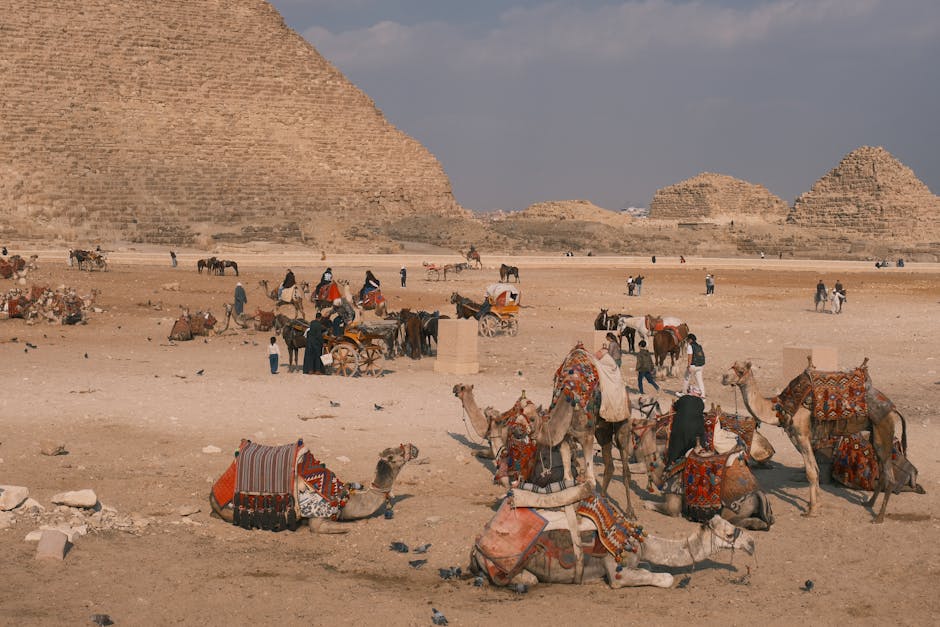
The Great Pyramids of Giza stand as one of humanity’s most remarkable achievements, yet despite centuries of study, these ancient monuments continue to harbor mysteries that fascinate archaeologists, historians, and curious minds alike. Beyond their imposing presence on the Egyptian landscape, the pyramids conceal engineering marvels, mathematical precision, and cultural secrets that challenge our understanding of ancient civilizations. Here are fifteen remarkable facts about these timeless structures that reveal just how extraordinary they truly are.
Ancient Engineering Marvels Revealed
1. The Original Gleaming White Exterior
The Great Pyramid of Khufu wasn’t always the sandy brown structure we see today. Originally, it was covered in highly polished white Tura limestone casing stones that would have made the pyramid shine brilliantly in the Egyptian sun. These smooth outer stones were so reflective that ancient observers described the pyramid as a glowing beacon visible from miles away. Most of these precious stones were removed over centuries and repurposed for building projects in Cairo, leaving only the rough inner core we see today.
2. The Mysterious Internal Temperature
The interior chambers of the Great Pyramid maintain a constant temperature of 20 degrees Celsius (68 degrees Fahrenheit), which happens to be the average temperature of the Earth. This remarkable climate control occurs regardless of the scorching desert heat outside or cooler nighttime temperatures, suggesting sophisticated understanding of thermal properties and architectural design.
3. Alignment with True North
The Great Pyramid is aligned to true north with an accuracy of better than four minutes of arc, which translates to a margin of error of less than 0.067 degrees. This level of precision is extraordinary considering the ancient Egyptians had no compasses or modern surveying equipment. Even more impressive, this alignment is more accurate than the Greenwich Observatory in London, which was built thousands of years later.
4. The Eight-Sided Design
While the Great Pyramid appears to have four sides, it actually has eight. Each of the four faces is slightly indented along the center line from base to apex, creating a subtle concave effect. This feature is almost impossible to detect from the ground and can only be seen from the air under specific lighting conditions during the spring and autumn equinoxes. The purpose of this design remains debated among scholars.
Mathematical and Astronomical Precision
5. The Golden Ratio Embedded in Stone
The Great Pyramid’s dimensions incorporate the golden ratio (phi), approximately 1.618, which appears throughout nature and has been used in art and architecture for millennia. The ratio of the pyramid’s height to half its base length equals phi with remarkable accuracy, suggesting the ancient Egyptians possessed advanced mathematical knowledge.
6. Pi Encoded in the Architecture
The relationship between the pyramid’s height and its perimeter encodes the value of pi (3.14159). If you divide the perimeter of the pyramid’s base by twice its height, you get a number very close to pi. Whether this was intentional or coincidental continues to spark debate, but the precision suggests deliberate incorporation of this fundamental mathematical constant.
7. Star Shaft Alignments
The so-called “air shafts” in the King’s and Queen’s chambers aren’t actually ventilation systems. These narrow passages align with specific stars that were significant in ancient Egyptian religion. The southern shaft from the King’s Chamber points to where Orion’s Belt would have appeared around 2450 BCE, while the northern shaft aligned with the circumpolar stars the Egyptians associated with immortality.
8. The Speed of Light Connection
The coordinates of the Great Pyramid’s location are 29.9792458°N, and the speed of light in a vacuum is 299,792,458 meters per second. This numerical coincidence has sparked considerable interest, though skeptics note that this only works with specific modern measurement conventions. Nevertheless, the correlation remains a fascinating curiosity.
Construction Mysteries and Methods
9. The Massive Scale of Labor
Contrary to popular belief, the pyramids were not built by slaves but by skilled workers who were well-fed and housed in nearby workers’ villages. Archaeological evidence suggests that approximately 20,000 to 30,000 workers, including permanent employees and rotating seasonal laborers, constructed the Great Pyramid over roughly 20 years. This required setting one 2.5-ton block every two to three minutes during daylight hours.
10. The Precision-Cut Granite Blocks
The granite blocks in the King’s Chamber, some weighing up to 80 tons, were transported from quarries in Aswan, over 500 miles away. These blocks fit together so precisely that a piece of paper cannot fit between them. The cutting and shaping techniques required to achieve this precision with copper tools and stone pounders demonstrate remarkable craftsmanship and patience.
11. The Lost Capstone Mystery
The pyramidion, or capstone, that originally topped the Great Pyramid has never been found. Historical accounts suggest it may have been made of gold, electrum, or gilded stone, serving as the pyramid’s crowning glory. Its disappearance remains one of the enduring mysteries, with theories ranging from ancient theft to the possibility it was never placed at all.
Hidden Chambers and Recent Discoveries
12. The Newly Discovered Void
In 2017, scientists using cosmic-ray muon radiography discovered a large void above the Grand Gallery within the Great Pyramid. This previously unknown space, at least 100 feet long, has sparked intense speculation about its purpose and contents. Researchers continue to study this chamber without invasive excavation techniques.
13. The Mysterious Shafts’ True Purpose
Recent robotic exploration of the narrow shafts extending from the Queen’s Chamber revealed doors with copper handles and hieroglyphic markings. When cameras finally peered beyond these doors in 2002, they found another blocking stone, deepening the mystery of what these passages were designed to protect or symbolize in ancient Egyptian belief systems.
14. The Subterranean Chamber
Deep beneath the pyramid, cut into the bedrock, lies an unfinished chamber that remains enigmatic. This rough-hewn space differs dramatically from the precisely crafted chambers above. Some theories suggest it was an abandoned first attempt at a burial chamber, while others propose it held symbolic significance in the pharaoh’s journey to the afterlife.
15. The Ancient Graffiti Marks
Hidden within the pyramid’s relieving chambers above the King’s Chamber are the only references to Khufu found inside the structure. These quarry marks, including the pharaoh’s name, were painted on the blocks by work gangs and were never meant to be seen. Their discovery in the 19th century helped confirm the pyramid’s builder and provided insights into the construction process.
Enduring Legacy
These fifteen secrets represent just a fraction of what makes the Great Pyramids so captivating. Each discovery raises new questions while answering others, reminding us that despite our technological advances, ancient civilizations possessed knowledge and capabilities that continue to astound us. The pyramids stand not merely as tombs for pharaohs but as testaments to human ingenuity, ambition, and the timeless desire to create something that transcends mortality. As modern technology allows us to peer deeper into these structures without causing damage, we can expect more revelations that will continue to reshape our understanding of ancient Egypt and the remarkable people who built these eternal monuments.
