

















1 / 20 Questions
0 Points

Which U.S. state has most of the oldest Bristlecone Pines?

Utah

Nevada

California

Arizona

Points won
0
Correct score
0%

More questions

More Articles

Did You Know? 12 Fascinating Facts About Numbers

Did You Know? 12 Fascinating Facts About Numbers

⏱️ 7 min read

Numbers are the universal language of our world, forming the foundation of mathematics, science, and everyday life. Yet beneath their familiar faces lie surprising patterns, peculiar properties, and remarkable stories that often go unnoticed. From ancient civilizations to modern computing, numbers have shaped human history in unexpected ways. The following collection reveals twelve intriguing facts about numbers that demonstrate their beauty, mystery, and power beyond simple counting.

Remarkable Properties and Mathematical Curiosities

1. Zero's Revolutionary Journey

Zero wasn't always considered a number. Ancient civilizations like the Greeks and Romans had no symbol for zero, making complex calculations extraordinarily difficult. The concept of zero as both a placeholder and a number in its own right originated in India around the 5th century CE, developed by mathematician Brahmagupta. This revolutionary idea eventually traveled to the Arab world and then to Europe, fundamentally transforming mathematics and enabling the development of algebra, calculus, and modern computing. Without zero, the digital age would have been impossible.

2. The Mysterious Prime Number Distribution

Prime numbers appear to occur randomly along the number line, yet they follow mysterious patterns that mathematicians still struggle to understand completely. The Riemann Hypothesis, one of the most important unsolved problems in mathematics with a million-dollar prize for its solution, concerns the distribution of prime numbers. Primes become less frequent as numbers grow larger, yet they never stop appearing—there are infinitely many prime numbers, a fact proven by Euclid over 2,000 years ago.

3. The Perfect Number Phenomenon

A perfect number equals the sum of its proper divisors, excluding itself. The number 6 is the smallest perfect number because 1 + 2 + 3 = 6. The next perfect number is 28 (1 + 2 + 4 + 7 + 14 = 28). Perfect numbers are extremely rare, and all known even perfect numbers follow a pattern discovered by Euclid. Remarkably, mathematicians still don't know whether any odd perfect numbers exist, despite searching for millennia. Only 51 perfect numbers have been discovered as of today, and the largest contains over 49 million digits.

4. Fibonacci's Natural Code

The Fibonacci sequence begins with 0 and 1, with each subsequent number being the sum of the two preceding ones: 0, 1, 1, 2, 3, 5, 8, 13, 21, and so on. This mathematical pattern appears throughout nature with astonishing frequency: in the spiral arrangement of sunflower seeds, the branching of trees, the arrangement of pine cones, the breeding patterns of rabbits, and even in the proportions of the human body. The ratio between consecutive Fibonacci numbers approaches the golden ratio, approximately 1.618, which has fascinated artists and architects for centuries.

Numbers in Culture and Symbolism

5. Seven's Universal Significance

The number seven holds special status across virtually every human culture and religion. There are seven days of the week, seven continents, seven colors in the rainbow, and seven notes in the musical scale. Ancient astronomers identified seven classical planets, religions reference seven heavens, and cognitive psychology has identified that humans can typically hold seven items in short-term memory (plus or minus two). This prevalence isn't coincidental—seven represents the combination of the physical world (four) and the divine or spiritual (three) in many traditions.

6. Thirteen's Controversial Reputation

Triskaidekaphobia, the fear of the number thirteen, is so prevalent that many buildings skip the thirteenth floor, airlines avoid row thirteen, and some people refuse to conduct important business on the thirteenth day of the month. This superstition may stem from various sources: there were thirteen people at the Last Supper, Norse mythology tells of a disastrous banquet for twelve gods crashed by a thirteenth uninvited guest, and the number thirteen disrupts the completeness of twelve. Paradoxically, in some cultures like Italy and China, thirteen is considered lucky.

Mathematical Oddities and Surprises

7. The Infinite Hotel Paradox

German mathematician David Hilbert illustrated the bizarre properties of infinity with his famous hotel paradox. Imagine a hotel with infinitely many rooms, all occupied. When a new guest arrives, the hotel can accommodate them by moving the guest in room 1 to room 2, the guest in room 2 to room 3, and so on, freeing up room 1. This demonstrates that infinity plus one still equals infinity, and challenges our intuitive understanding of numbers and space. The concept reveals fundamental truths about different sizes of infinity in set theory.

8. Pi's Endless Mystery

Pi (π), the ratio of a circle's circumference to its diameter, is perhaps the most famous irrational number. Its decimal representation never ends and never repeats, continuing infinitely without pattern: 3.14159265358979... and beyond. Mathematicians have calculated pi to over 50 trillion digits, yet its mysteries remain. Pi appears in unexpected places throughout mathematics and physics, from probability theory to quantum mechanics. Every possible number sequence theoretically exists somewhere within pi's infinite digits, meaning your phone number, birthdate, and even this article encoded numerically might be found within pi.

9. The Birthday Paradox's Counterintuitive Truth

In a room of just 23 randomly chosen people, there's a greater than 50% probability that two people share the same birthday. With 70 people, the probability rises to 99.9%. This seems impossible given that there are 365 days in a year, but the mathematics is sound. The paradox illustrates how poorly human intuition handles probability. We instinctively think about the chance of someone matching our specific birthday, rather than any two people matching each other, which involves far more possible combinations.

Numbers in the Modern World

10. Googol and Googolplex's Mind-Bending Scale

A googol is 1 followed by 100 zeros, a number larger than all the atoms in the observable universe. Yet a googolplex makes a googol seem tiny—it's 10 raised to the power of a googol, or 1 followed by a googol of zeros. You couldn't write out a googolplex even if you used every atom in the universe as a digit. These numbers, coined by nine-year-old Milton Sirotta in 1938, demonstrate how quickly numbers can exceed physical reality, existing purely in the abstract realm of mathematics.

11. The Binary Revolution

Every digital device operates using only two numbers: 0 and 1. The binary system, base-2 numbering, represents all information—text, images, videos, and calculations—as sequences of these two digits. German mathematician Gottfried Wilhelm Leibniz formalized binary notation in the 17th century, but it didn't achieve practical importance until the development of electronic computers. The simplicity of binary makes it ideal for electronic circuits, which can easily represent two states: on or off, current or no current. This elegant system powers our entire digital civilization.

12. Graham's Number's Incomprehensible Magnitude

Graham's number, used in a mathematical proof by Ronald Graham in 1971, is so astronomically large that it cannot be expressed using conventional notation. Even writing it in exponential form or using powers and factorials proves inadequate. The number is so vast that if every digit were written in the smallest possible space, it would exceed the information storage capacity of the universe. Yet despite its incomprehensible size, Graham's number is finite—there are larger numbers, and infinity remains infinitely larger still. This number represents the extreme edge of mathematical thinking.

Conclusion

These twelve facts barely scratch the surface of numerical fascination. Numbers are far more than tools for counting and calculating—they embody patterns that reveal deep truths about reality, bridge cultures through their symbolic meanings, and challenge our understanding of infinity and scale. From the ancient discovery of zero to the modern binary code running our computers, from the perfect symmetry of perfect numbers to the seeming randomness of primes, numbers continue to surprise, perplex, and inspire. Whether appearing in nature's designs, cultural traditions, or abstract mathematical proofs, numbers remain humanity's most powerful language for describing and understanding the universe. Their study reveals that mathematics is not merely a human invention but a discovery of fundamental patterns woven into the fabric of existence itself.

Did You Know? 10 Fascinating Facts About Castles

Did You Know? 10 Fascinating Facts About Castles

⏱️ 8 min read

Castles have captured human imagination for centuries, standing as magnificent testaments to medieval ingenuity, power, and architectural brilliance. These fortified structures served as military strongholds, royal residences, and symbols of authority throughout the Middle Ages and beyond. While most people recognize castles from fairy tales and historical dramas, the real stories behind these imposing structures are often more fascinating than fiction. From ingenious defense mechanisms to surprising everyday realities, castles hold secrets that reveal much about medieval life, warfare, and society.

Remarkable Castle Facts That Challenge Common Perceptions

1. Castle Toilets Drained Directly Down Exterior Walls

Medieval castles featured surprisingly sophisticated sanitation systems called garderobes—essentially toilets built into the castle walls. These small rooms contained stone or wooden seats with holes that dropped waste through vertical shafts directly down the exterior walls or into moats below. While this might seem primitive, it was actually quite advanced for the era. The waste would either fall into a cesspit that servants periodically cleaned, or directly into the moat or river. Some clever attackers occasionally attempted to infiltrate castles by climbing up these waste chutes, though such attempts were rare and extremely unpleasant. The garderobe's name actually comes from the French words for "guard robe," as people discovered that hanging clothes in these chambers helped repel moths due to the ammonia fumes.

2. Arrow Slits Were Scientifically Designed for Maximum Protection

The narrow vertical openings in castle walls, known as arrow slits or loopholes, were far more sophisticated than they appear. These defensive features were carefully engineered to provide archers with a wide field of fire while exposing minimal surface area to enemy projectiles. The slits were typically narrow on the outside—sometimes just a few inches wide—but splayed widely on the interior, allowing defenders to shoot arrows at various angles. Different designs served different purposes: cross-shaped slits accommodated crossbows, while circular openings at the bottom were added later for early firearms. The positioning of these slits was mathematically calculated to eliminate blind spots and ensure overlapping fields of fire, creating deadly kill zones for any attacker attempting to scale the walls.

3. Murder Holes Rained Death on Invaders

Among the most fearsome defensive features of medieval castles were murder holes—openings in the ceilings of gatehouses and passageways. When enemies breached the outer gates, defenders could pour or drop various deadly substances through these holes onto the invaders trapped below. Contrary to popular belief, boiling oil was rarely used due to its expense and scarcity; instead, defenders typically used boiling water, quicklime, heated sand, or heavy stones. Quicklime was particularly effective as it would burn skin and, when mixed with water, would create an exothermic reaction causing severe burns. Murder holes also allowed defenders to extinguish fires if attackers attempted to burn down the gates, making them serve both offensive and defensive purposes.

4. Castle Walls Were Deliberately Built at Angles

Medieval architects discovered that sloped or angled walls, called taluses or batters, provided superior defense against siege weapons and mining operations. These thickened, sloping bases served multiple purposes: they made walls more difficult to undermine through tunneling, caused dropped objects to bounce outward into attacking forces, and helped prevent siege towers from reaching the upper walls. The angle also made it harder for battering rams to strike the wall perpendicularly with full force. Additionally, this design provided better structural stability, distributing the wall's weight more effectively and making the fortress more resistant to both siege weapons and earthquakes. This architectural innovation represented a significant evolution in defensive military engineering.

5. The Most Expensive Castle Cost More Than the King's Annual Income

Castle construction required astronomical sums of money, with some projects bankrupting entire regions. Edward I of England spent approximately £27,000 building Conwy Castle in Wales between 1283 and 1289—equivalent to roughly $150 million in today's currency. Even more staggering, this represented more than his entire annual royal income at the time. Building a major castle required hundreds or even thousands of workers, including master masons, carpenters, blacksmiths, and laborers. Materials had to be quarried and transported, sometimes over great distances. The construction of Dover Castle consumed an estimated 4,000 to 6,000 workers over multiple decades. These costs explain why castle building was exclusively the domain of monarchs and the wealthiest nobles, serving as both military necessities and powerful symbols of financial might.

6. Spiral Staircases Were Built Clockwise for Strategic Reasons

The spiral staircases in castle towers almost always turned clockwise when ascending, and this design was no accident. This configuration gave a significant advantage to defenders fighting from above, as most people are right-handed. A defender retreating up the stairs would have the central column on their left, giving their sword arm full range of motion. Meanwhile, attackers climbing the stairs would have the central pillar on their right side, restricting their ability to swing weapons effectively. This subtle architectural choice could mean the difference between life and death during a castle breach. Some castles built by left-handed lords featured counter-clockwise staircases, though these were rare exceptions that proved the rule.

7. Castles Were Originally Painted in Bright Colors

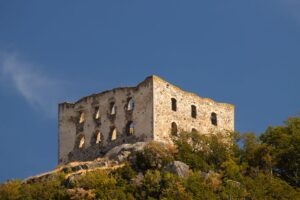
The gray stone castles we see today bear little resemblance to their original appearance. Medieval castles were typically covered in white lime-based plaster and often painted in bright colors both inside and out. Exteriors were frequently whitewashed to protect the stone from weathering, making castles gleaming white landmarks visible for miles. Interiors featured vibrant murals, painted patterns, and colorful decorations on walls and ceilings. This whitewashing and painting served practical purposes: it sealed the stone against moisture, made interiors brighter by reflecting light, and demonstrated wealth and status. The bare stone ruins we associate with castles today only emerged after centuries of abandonment when the plaster eroded away, revealing the gray stone beneath.

8. Concentric Castle Design Revolutionized Medieval Defense

The development of concentric castles—fortifications featuring multiple rings of defensive walls—represented a quantum leap in military architecture. These castles had an inner wall higher than the outer wall, allowing defenders on both levels to fire at attackers simultaneously without obstructing each other. If enemies breached the outer wall, they would find themselves trapped in the killing ground between walls, exposed to fire from multiple directions with nowhere to hide. This design, perfected by Edward I after observing Byzantine and Middle Eastern fortifications during the Crusades, made castles nearly impregnable to medieval siege tactics. Caerphilly Castle in Wales exemplifies this design, with its elaborate system of concentric walls and extensive water defenses creating one of the most formidable fortresses ever built.

9. Some Castles Were Built in Less Than Two Years

While many castles took decades to complete, some were constructed with remarkable speed when urgency demanded it. Richard I of England built Château Gaillard in Normandy in just two years (1196-1198), employing thousands of workers in shifts that continued day and night. The king personally supervised construction and spared no expense, calling it his "fair daughter." This rapid construction was possible through massive resource allocation, simplified designs that prioritized defense over comfort, and the use of prefabricated elements. Motte-and-bailey castles—early timber fortifications built on earthen mounds—could be erected in as little as eight days by a skilled workforce, providing immediate defensive positions during military campaigns. These timber castles served as temporary fortifications until permanent stone structures could be built.

10. Castle Keeps Served as Last-Resort Panic Rooms

The keep, or donjon, was the strongest and most secure structure within a castle, functioning as the medieval equivalent of a fortified panic room. If attackers breached the outer defenses, the lord, his family, and garrison would retreat to this heavily fortified tower, which could withstand siege independently. Keeps contained wells for water, storage for food, and were designed to be defensible by a small force. The walls were typically 10 to 15 feet thick, with the entrance often located on the second floor, accessible only by removable wooden stairs or ladders. Some keeps, like the Tower of London's White Tower, were luxurious residences during peacetime, but their primary purpose was always survival. This final defensive position meant that even if the castle fell, the keep might hold out long enough for reinforcements to arrive or for favorable surrender terms to be negotiated.

The Enduring Legacy of Castle Engineering

These ten fascinating facts reveal that castles were far more than simple stone fortresses. They were sophisticated expressions of medieval engineering, strategic military thinking, and social organization. From their ingenious defensive features like murder holes and spiral staircases to surprising details about their construction costs and colorful appearances, castles embodied the pinnacle of medieval technology and architectural achievement. Understanding these structures provides invaluable insights into how medieval societies approached problems of defense, daily living, and the projection of power. Today's castle ruins, stripped of their plaster and paint, offer only a shadow of their original magnificence, yet they continue to inspire wonder and remind us of an era when these fortifications dominated the landscape and shaped the course of history.